A Botanist Painting Drawing Flower Plant
/https://tf-cmsv2-smithsonianmag-media.s3.amazonaws.com/filer/44/42/4442d799-25a0-413d-854b-e243654af81c/alicetangerini10.jpg)
Alice Tangerini'south botanical illustrations all begin the same style: with a seemingly unproblematic line cartoon, in which she explores a plant'south features—leaves, seed, stem, maybe a bloom or two. Next, she uses a microscope to investigate her specimen's tiny hairs and veins, recreating their likeness in delicate lines with the force per unit area-sensitive pen of an architect or engineer drafter. Tangerini has adopted the tools and the vision of both the creative person and scientist for her work, which is, every bit she describes it, "fine art in the service of science."
Tangerini is the first and simply botanical illustrator at the Smithsonian'due south National Museum of Natural History, where she has been putting her stamp on plant science for 46 years. Over the course of her career, Tangerini has created hundreds of illustrations from over 1,000 dissimilar constitute species from all over the earth. Her artwork has appeared in books, peer-reviewed scientific discipline journalsand museum exhibits. Prominent botanist Warren H. Wagner calls Tangerini "irreplaceable" in the field of botanical illustration.
Though some universities now offer degrees in scientific illustration—similar the Academy of Iowa's Biological and Pre-medical Illustration program and the University of Chicago'southward Medical Analogy program—no such program existed when Tangineri embarked on this field in the late 1960s. Her entrance into scientific illustration relied on a scrap of luck (and a lot of skill), resembling more of a teacher and apprentice relationship rather than today'south formal college road.
"I'd ever been interested in drawing, even from childhood," recalls Tangerini. "I grew up in a neighborhood where even the neighbors knew I was the 'daughter who liked to draw.'" One summer in between college semesters at her inferior college in Kensington, Maryland, Tangerini was looking for a summertime job. It was one of these neighbors who suggested that Tangerini talk to Lyman Smith, a botanist at the Smithsonian's National Herbarium who happened to alive in the neighborhood and to be looking to hire an illustrator.
When she went to introduce herself to Smith for the outset fourth dimension, she brought forth a loftier schoolhouse art portfolio of equus caballus and dog drawings. The closest matter to a plant that Tangerini had fatigued up to that point was the grass nether the horses' hooves. "He raised his eyebrows and said 'I'll just requite you a try,'" she recalls now. "And that was exactly how information technology started."
The adjacent week Tangerini met Lyman at the museum for a test run. Lyman set out a stale plant specimen, a slice of bristle board, a pencil, and a bottle of ink and with a pen. Then he left. Hours later on, he returned to see what Tangerini had done. "I drew a dead plant that looked like a dead plant. Just exactly like that expressionless found," she says. He told her that side by side time she should unfold the leaves. And that was her get-go lesson.
She continued to work for Lyman on the weekends and during the summers, and that became her training as a botanical illustrator.
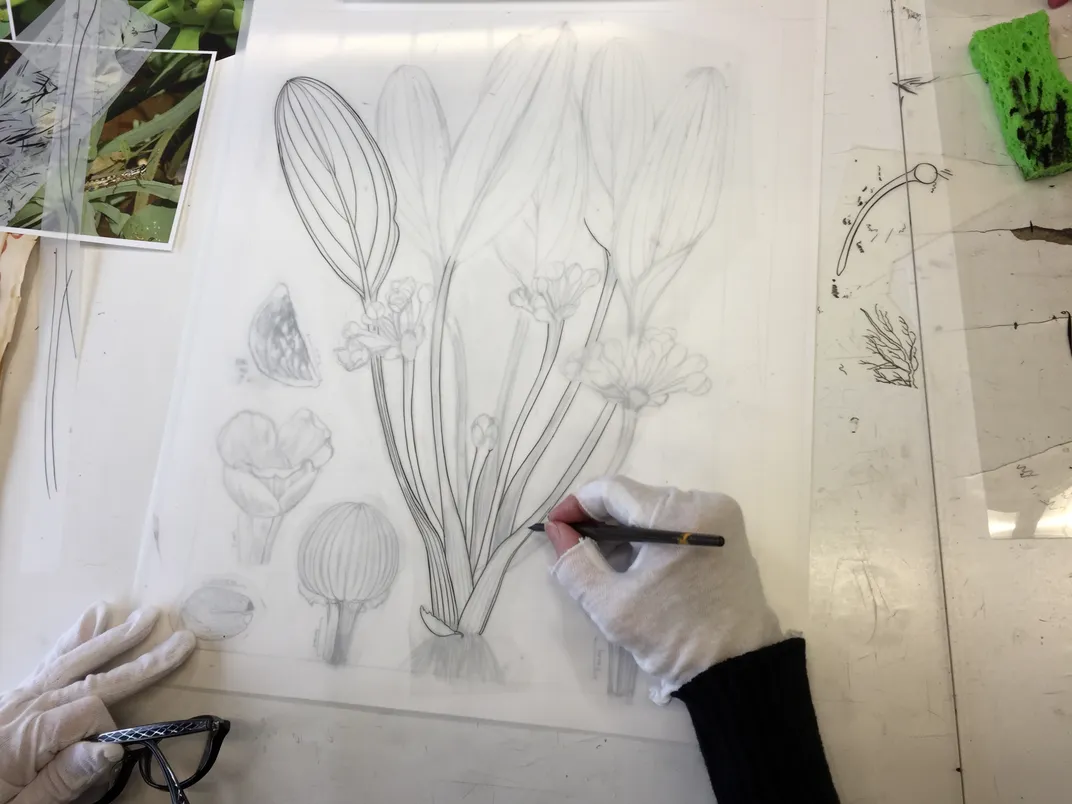
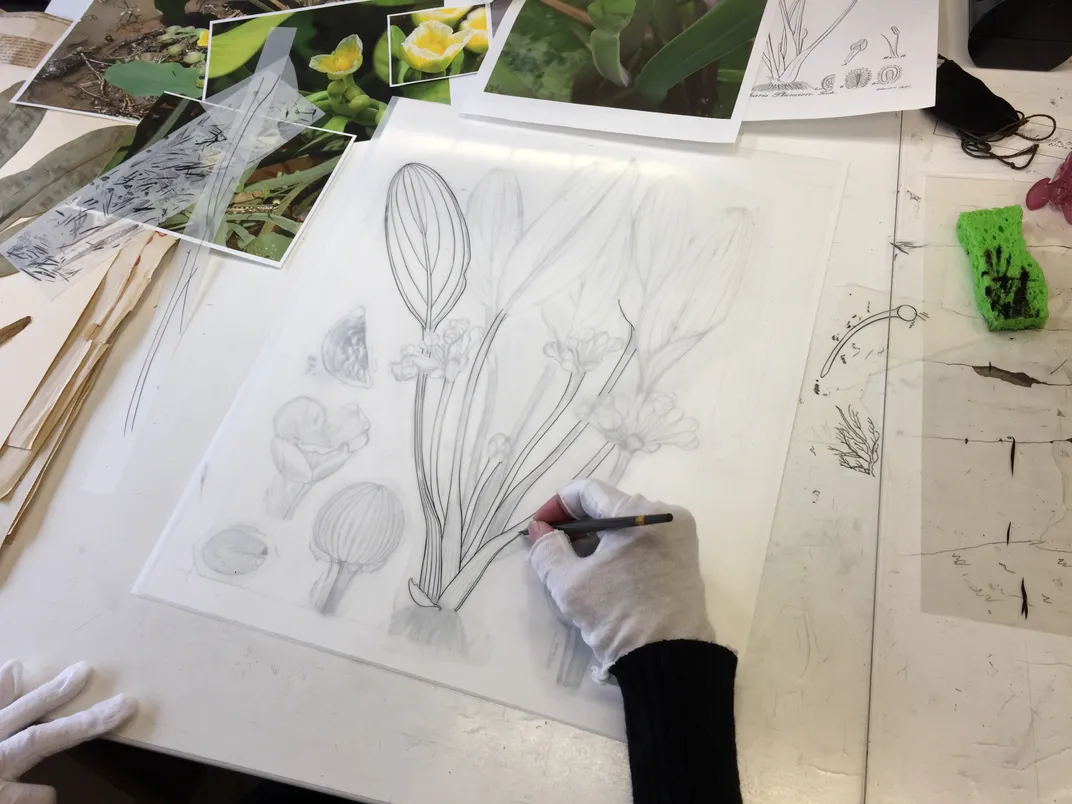
Decades after offset as a botanical illustrator at the Smithsonian in 1972, Tangerini nonetheless draws dead plant specimens from all over the world, some over 200 years one-time. But at present she knows how to imbue them with new life. Her lines, careful and full of intention, smoothly catamenia from thick to fine, creating a sense of animation. And though ane convention in botanical illustration is to add a lite source from the upper left of the drawing, Tangerini's way of using heavy line shading gives plants the appearance of emitting a light of their own.
Tangerini does not see herself as a fine creative person, even though she graduated with a fine arts degree from Virginia Commonwealth Academy. "Scientific illustration is usually divers past the audition. You're drawing for a scientific audience," she explains. "I remember of fine arts equally that in which yous piece of work for yourself. You are deciding yourself 'what am I doing, what exercise I desire to present to an audience that I make up one's mind.'"
The categorical dissever between aesthetic (plant portraits) and instructional (plant illustrations) representation is long-held. Instructional found analogy dates back to ancient and medieval Herbals, which were books used by healers and apothecaries that contained information about plants' medicinal properties and described how the plants should be prepared for medicinal utilize. Accompanying the text were institute illustrations, which needed to be instructional enough for a reader to place the constitute in nature, including an accurate rendering of the plant's proportions, characteristics of the plant, and the colors of the leafage and any flowers or fruit. For healers and herbalists, the stakes were high; the wrong plant or preparation could result in decease.
Tangerini follows closely in this aboriginal tradition, with one exception: color does not feature prominently in her oeuvre. Since about of Tangerini's models are dried specimens, they don't take much color when she receives them. "[Colour] is non even essential...that is not a taxonomic denominator, it does not divide species," she explains. Someone's interpretation of a colour is subjective, so the plant characteristics that could be recognized past botanists in any part of the world are those that are taxonomically significant: found morphology, structure, and the internal parts of the institute.
Another distinction is that, for ancient and medieval illustrators, mod taxonomy did not yet exist equally a standardized system of identification. It wasn't until the 18th and 19th century—when naturalist and eugenicist Ernst Haeckel began popularizing the field of scientific illustration through hundreds of pubished artworks of microscopic plants and animals—that the type of botanical precision that Tangerini looks for became an integral part of the arts and crafts.
Historians of science like Ann Shteir, Barbara Gates and Sally Kohlstedt have shown that botanical illustration during this menstruation offered women an alternative pathway into scientific discipline. Either as independent illustrators or unrecognized illustrators for their male relatives, hundreds of women illustrators were central to taking the newly developed taxonomic linguistic communication of male botanists and transferring it to accurate visual representation These women brought scientific accurateness to the botanical: Though many have faded into obscurity, their piece of work established the foundation for modern botanical illustration.
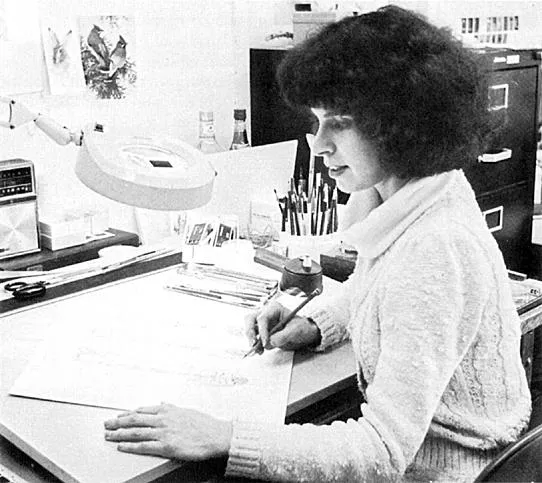
The aim for scientific accuracy at the management of a scientist does not, however, mean that all illustrations look the same or that illustrators practice not infuse imagination and creativity into their piece of work. Tangerini is, by all definitions of the word, an artist. "We have command over media and our implements," she points out. "I consider every cartoon to be a challenge because every time I put pen to newspaper or my stylus to the screen I have to make up one's mind where I'g putting my lines and my shadows or dots or colors to better show what the scientist has given me."
When Tangerini began illustrating, scientific illustrators were so small in number that an manufacture simply didn't exist to supply them with specialized tools. (Her field remains small; funding constraints mean many museums and botanical gardens typically employ just one or two illustrators.) As a event, it was customary to use the tools of architects, engineering science drafters and calligraphers.
Similarly, today's illustrators accept adopted tools from the field of graphic design, opting for stylus and graphics tablets over pen and paper, and using artistic software like Adobe Photoshop. "Fifty-fifty if you lot can draw or pigment, you still need to exist able to use all these programs," says Fall von Plinsky, a former illustrator for the New York Botanical Garden. "It's one of those things that broadens your career and projection capabilities past getting to know them, the design and illustrator aspect."
Still Tangerini yet prefers her vintage pens and pencils with paper. Afterwards so many years, she says, her hands are merely used to doing it that way. Simply there's another reason she prefers these implements: preserving the long history of her craft. These vintage tools, flexible nips and pens, permit her to attain the style in which she wanted to follow when she started: engraving. "I still expect at sometime engravings to run across the line work — it'south beautiful," she says. She has acquired many of her tools from other illustrators and can't be constitute in the market anymore. "I learn their tools considering to me it's similar a history. A niggling history of cartoon that is slowly vanishing."
On summit of her illustrating duties, Tangerini now curates the botanical fine art collection in the NMNH and the Smithsonian'south Catalog of Botanical Illustrations. Only what she loves most about her work is still the process of reconstructing a dried specimen on paper. "Figuring out in my head how I correspond this dried dead plant in a way that I feel volition look aesthetically beautiful on a page that I tin can design myself ... information technology's very rewarding," she says. Sometimes in this procedure, she finds some tiny item that even the botanist couldn't come across. "I'm putting information technology under the microscope to draw information technology. I have to really await at information technology, because I take to do an interpretation of something that is stale and try to get in as though it is living."
Information technology is through this act of reanimation—in the noticing of undiscovered details and determining the all-time means to represent them on newspaper—that Tangerini finds the lyrical in the scientific. Equally she puts it, "that in itself is an expression of myself."
Source: https://www.smithsonianmag.com/science-nature/meet-woman-who-meticulously-illustrates-plants-name-science-180969544/
0 Response to "A Botanist Painting Drawing Flower Plant"
Post a Comment